
Everyday Wellbeing, Thoughtfully Supported
Most people come to supplements the same way. Something feels off. Energy dips in the middle of the afternoon and never quite recovers. Digestion becomes unpredictable. The scales stop moving despite a month of doing everything right. So you go looking for help, and you find a wall of bottles making very large promises in very small print.

Fitlab Nutrition exists because that wall is a poor place to make a decision about your own body.
We are a UK-founded supplement company built around a fairly unglamorous idea: that a supplement should tell you exactly what is in it, in what amount, and on what basis anyone thinks that amount will do anything at all. That is the whole standard. It sounds like the bare minimum, and it should be, but a great deal of this industry does not meet it.
We work across three areas — energy, metabolic health and gut health — because they are the three things people most often come to us about, and because they are the three areas where the science is mature enough to formulate honestly. We do not have a product for everything. We would rather cover a small amount of ground properly than a large amount of ground vaguely.
If you have ever turned a bottle over, read the label, and felt no more informed than before you picked it up, you already understand why Fitlab Nutrition was started.
It is worth saying what we are not, as well. We are not a brand that will tell you your body is broken so that we can sell you the repair. We are not interested in the corner of this market that trades on insecurity, where the copy is engineered to make you feel slightly worse about yourself on the way to the checkout. And we are not a lifestyle company that happens to sell capsules — we do not have a philosophy of living to share with you, and we are not going to tell you what your morning should look like.
What we have is a fairly narrow set of competencies. We understand formulation. We understand what the human research does and does not support. We know how to source raw materials that are what they claim to be, manufacture them under conditions we can account for, and get an independent laboratory to confirm the result before it reaches you. That is the job. Everything else on this page is an explanation of how we go about it, and you are welcome to read it critically, because that is exactly the frame of mind we would want you in when you assess anybody's supplement — including ours.
There was no lightning-bolt moment. There was a slow accumulation of irritation.
The people behind Fitlab Nutrition came at this from the inside — from training, from nutrition, from the long unglamorous business of trying to help people feel better and finding that half the products on the shelf made that job harder rather than easier. You would recommend something sensible and the person would come back with a competitor's bottle covered in words like advanced and maximum strength, and you would turn it over and find a proprietary blend of eleven ingredients totalling 300mg, which tells you almost nothing about how much of any single one you are actually taking. It could be 290mg of rice flour. Legally, they never have to say.
That is not an exaggeration for effect. It is how a great deal of the market works, and it works that way because it is cheaper, and because it is very difficult for a customer to catch.
The other frustration was quieter and more damaging. Supplements are routinely sold as substitutes for the things that actually move the needle. Transform your body. Melt fat. Fix your gut in seven days. People buy them, take them, change nothing else, get nothing, and conclude that supplements as a category are a con. Some of them are. But some are genuinely useful, and the useful ones get tarred along with the rest because the marketing set an expectation no capsule on earth could meet.
So the brief we set ourselves was narrow and a little stubborn. Formulate to the doses the research actually used. Put every one of those doses on the front of the label where anyone can check them. Test the finished product through an independent laboratory rather than taking a supplier's word for it. Manufacture in the UK to standards we can point to. And then describe what the product does in language a reasonable person would still consider fair three months later, when the novelty has worn off and they are judging us on results.
We should be honest that none of this was arrived at cleanly. Early on, we spent a great deal of time on formulas that never went anywhere, because when we got to the point of writing out the dose and comparing it to the literature, the honest version cost more than the market appeared willing to pay. There were conversations about whether the studied dose was really necessary, or whether something close enough would do. Every brand has those conversations. The difference is only in where you decide to land, and we landed where we did because we could not see a way to write "clinically relevant" on a label and then quietly not mean it.
There were also things we got wrong and had to redo. Suppliers we walked away from after the paperwork did not hold up. Ingredients we were enthusiastic about until we read the underlying trials properly and found the effect was smaller and shakier than the summaries suggested. That is an uncomfortable process, because it usually means going back to the start with a formula you had already grown attached to. It is also the only process that produces something you can stand behind afterwards.
That is Fitlab Nutrition. It is not a complicated business. It is just a set of decisions we have agreed not to walk back when they become inconvenient — and the whole point of writing them down publicly, here, is that it makes walking them back that much harder.

We start from the body, not the bottle.
The reason a supplement helps or fails to help is almost always a question about what is happening physiologically first. Feeling flat at four in the afternoon is not a deficiency of caffeine. It might be a blood sugar pattern, or poor sleep, or a training load your recovery has not caught up with, or genuinely low iron or B12. Those have different answers. Reaching for the same capsule regardless is guesswork with a nice label on it.
So the philosophy at Fitlab Nutrition runs in this order:
The corollary is that we will sometimes tell you a supplement is not your answer. If someone is sleeping five hours a night, no energy formula in existence is going to fix their afternoons, and we would rather say so than take the sale and let them find out for themselves.
There is a second reason we work this way, and it is about trust rather than physiology. When a product is sold on a mechanism, you can check the mechanism. When it is sold on a feeling, you cannot check anything. A brand that explains why an ingredient should work has given you the tools to disagree with it, and a brand that only tells you how transformed you will feel has carefully given you nothing at all. We would rather be the first kind, even when the first kind is less persuasive in the short term.
It also changes how we handle uncertainty. Nutritional science is not physics. Trials are frequently small, populations differ, and effects that look convincing in one study sometimes shrink or vanish when someone larger and better funded tries to repeat them. Pretending otherwise would be easier to write and far easier to sell. But a customer who has been told something is definitive, and then finds out it was not, has been given a good reason never to believe us again — and rightly so.
Making science accessible does not mean making it sound easy. It means giving you enough of the mechanism, and enough of the doubt, to make your own call — which is, in the end, the only kind of decision worth making about your own health.
Energy is the complaint we hear most and the one most poorly served by the market.
The default approach is stimulation: enough caffeine to override the signal that you are tired. That has a place — it is well studied and it works for what it does — but it is borrowing, not earning. If your energy problem is a production problem rather than an alertness problem, stimulants paper over it and leave the underlying issue exactly where it was.
Cellular energy is a manufacturing process. Your mitochondria take fuel and oxygen and convert them, through a long chain of steps, into the molecule your body actually spends. That chain has requirements. It needs B vitamins as cofactors at multiple points. It needs iron to carry oxygen to the tissue in the first place. It needs magnesium, which is involved in hundreds of enzymatic reactions and which a meaningful proportion of adults do not get enough of. Take any of those away and the line slows down — and no amount of shouting at the line makes it move faster.
Our approach to energy is to look at that production chain, identify where a formula can genuinely support it, and be honest about the difference between supporting production and producing a stimulant hit. Both have legitimate uses. They are not the same thing, and a product that quietly relies on the second while advertising the first is not being straight with you.
It is also worth being clear about what "tired" means, because people use one word for several different problems. There is sleepiness, which is a sleep debt and has one obvious remedy. There is fatigue, which is a heaviness that sleep does not always fix and which can point to anything from overtraining to low iron to something a doctor should be looking at. There is low motivation, which is often psychological before it is physiological. And there is the ordinary post-lunch slump, which is largely a matter of what you ate and how much of it. A supplement is a reasonable answer to some of these and no answer at all to others.
We would rather you knew which one you had. If your tiredness is persistent, unexplained and getting worse, please treat that as a reason to see a doctor rather than a reason to try a capsule. Genuine deficiencies show up on blood tests, and they are far better addressed with information than with guesswork. Where a formula fits is in the ordinary, unremarkable middle ground — supporting the machinery that turns your food into usable energy, so that a body already doing reasonable things has what it needs to do them.
This pillar carries more nonsense than any other, so we want to be careful with it.
Metabolic health is the broad question of how well your body manages fuel: how it handles blood sugar, how sensitive your tissues are to insulin, how it stores and releases energy, how appetite signals are working. It sits underneath a great deal of how you feel day to day, and it responds — genuinely, measurably — to what you eat, how you move and how you sleep.
What it does not do is respond dramatically to a capsule.
Here is the honest position at Fitlab Nutrition. There are ingredients with real evidence in this space. Some support appetite regulation. Some influence how quickly carbohydrate is absorbed. Some affect the way the body handles glucose after a meal. The effects are real and they are also modest, and they are measured in studies where the participants were eating sensibly and moving regularly, because that is the only context in which they are worth measuring at all.
So we formulate for metabolic support, we cite it honestly, and we say the part that other brands leave off: this works alongside your diet and your training, and it does not work instead of them. A supplement can make consistency slightly easier — take the edge off cravings, smooth out the appetite spikes that derail an otherwise good week. That is a genuinely useful thing. It is not a shortcut, and anyone selling you one is selling you something else.
Think about how weight management actually goes wrong for most people. It is rarely a lack of knowledge. Almost everybody knows roughly what they should be eating. It goes wrong on a Wednesday evening after a difficult day, when hunger is loud and willpower has already been spent on everything else, and one decision quietly undoes four good days. It goes wrong in the gap between meals when blood sugar drops and the nearest thing is the wrong thing. It goes wrong because staying consistent is hard, not because the plan was wrong.
That is the narrow place where a well-formulated supplement can be worth something. If it makes that Wednesday evening a little more manageable, it has not changed your metabolism in any dramatic sense, but it may well have changed your month. Small, unremarkable, compounding. We are entirely comfortable making that claim, because it is one we can support and because we would rather promise something modest and true than something enormous and hollow.
The gut has become fashionable, which is a mixed blessing. The underlying science is genuinely important and the marketing around it has run considerably ahead of what anyone can actually claim.
What we know is solid enough. You are carrying a very large community of microorganisms, mostly in your large intestine, and they are not passengers. They ferment the fibre you cannot digest. They produce short-chain fatty acids that feed the cells lining your colon. They interact with your immune system, a substantial share of which sits in the gut wall. They influence how you extract energy from food. When that community is disrupted — by illness, by antibiotics, by a long stretch of poor eating — people tend to feel it, and not only digestively.
What we do not know is far larger. There is no confirmed blueprint for the perfect microbiome. Strains are not interchangeable, and evidence for one strain at one dose does not transfer to a different strain simply because it shares a genus. Survival through stomach acid is a real formulation problem, not a marketing detail. And a great many products in this category are sold on the strength of the general story rather than any evidence about the specific organisms in that specific bottle.
Fitlab Nutrition works in gut health on strain-level evidence and honest counts, and we say clearly that a probiotic is a support to fibre, variety and fermented foods rather than a replacement for them. You cannot supplement your way out of a diet with no plants in it. What you can do, sensibly, is support a system you are already looking after.
Two practical points we think are worth knowing, because most brands would rather you did not.
The first is that a large number on the front of the bottle is not, on its own, a virtue. Live culture counts are typically stated at the time of manufacture, which tells you very little about how many organisms are still alive by the time the bottle has spent months in a warehouse and a fortnight in your kitchen. What matters is the count at the end of shelf life, under real conditions, for strains that can actually survive the journey through the stomach. That is a harder thing to guarantee and a much less impressive thing to print.
The second is that gut health is one of the areas where the effect of a supplement is most obviously conditional on everything else you are doing. The organisms you are trying to support live on fibre. If the fibre is not there, you are seeding a garden with no soil. So the honest recommendation, which costs us nothing to give because it is true, is to sort the plants first — variety, fibre, fermented foods where you enjoy them — and then use a supplement to support that, particularly through the periods when the system has taken a knock. That is a smaller role than the category usually claims. It is also the real one.

We would rather be judged on four specific commitments than on adjectives. Here is what each one actually involves.
Purity is not a word we use decoratively. It has a technical meaning and there is work behind it.
Every raw material has a specification: what it is, where it came from, how it was extracted, what percentage of the active compound it contains, and what else might be in there. That last part matters most. Botanical extracts can carry heavy metals from the soil they grew in. Some carry pesticide residues. Some carry microbial contamination if handling was poor. Some are simply not what the paperwork says — adulteration in the botanical supply chain is a well-documented problem, and a cheap extract that tests at half the stated strength is not a bargain, it is a fraud you paid for.
So we specify tightly, we source from suppliers who can produce real documentation, and we verify rather than assume. Standardised extracts, where they exist, are preferred for exactly this reason — a standardised extract is one guaranteed to contain a stated percentage of the compound the research was actually about, which means the dose on the label means something.
We also think about how ingredients behave together, because they do. Some nutrients compete for the same absorption pathway. Some improve the bioavailability of others substantially. Some forms are better tolerated than others at the same dose. A formula is not a list; it is a set of relationships, and building one properly takes longer than throwing everything recognisable into a capsule and calling it comprehensive.
Fitlab Nutrition was founded in the UK, is developed in the UK, and is produced to UK manufacturing standards.
That is not a flag-waving exercise. It is a statement about what happens between an ingredient arriving and a bottle leaving. Manufacturing in a regulated facility means documented processes, batch records, traceability, controlled environments, staff who are trained to a standard, and equipment that is cleaned and validated between production runs. It means that if a problem is ever found in a finished batch, it can be traced back through the chain to the specific raw material and the specific run that caused it.
None of that is visible to you as a customer. It does not change how the capsule looks. It costs more and it slows things down. It is also the difference between a product you can stand behind and a product you are simply hoping is fine.
This is the commitment we care about most, and it comes down to one deeply unsexy word: dose.
Almost every supplement worth buying is worth buying because of a body of human research. That research used a particular ingredient, in a particular form, at a particular amount, over a particular period. Change the amount and you are no longer running the study — you are running something else and hoping it turns out the same.
This is the industry's most common trick, and it is entirely legal. Include the ingredient everyone has heard of, at a fraction of the studied dose, and put it on the front of the label. Technically true. Practically useless. The customer buys on the strength of research that has no bearing on what is in their hand.
Fitlab Nutrition formulates to clinically relevant dosages. Where the evidence points to a specific amount, that is the amount that goes in, and it goes on the label in plain numbers so you can check it against the literature yourself. Where an ingredient's evidence is not strong enough to justify a dose we could defend, it does not go in — however good it would look on the box.
And then we test. Third-party testing means an independent laboratory, with no commercial interest in the result, verifying that what the label says is what the bottle contains, and that what should not be there is not there. We do it because a supplier's certificate of analysis tells you what the supplier believes, and the only way to know is to check. Testing that only reports back when the news is good is not testing. It is marketing with a lab coat on.
Every Fitlab Nutrition formula is vegan and gluten-free.
That is a small sentence covering a genuine formulation constraint. It rules out gelatine capsules, which are cheaper and easier to work with than plant-based alternatives. It rules out certain excipients, certain coatings, certain flow agents. It requires verification across the supply chain rather than at the final step, because a gluten-free formula filled on an uncleaned line is not gluten-free in any way that helps someone with coeliac disease.
We accepted those constraints because the alternative is a product that a meaningful number of people simply cannot take, for reasons that have nothing to do with whether it would work for them. Accessibility here means one thing: a good formula should not exclude you over a decision made for the manufacturer's convenience.
The process runs in roughly the same order every time.
The whole process is designed around one question, asked at every stage: if a customer could see this step, would we be happy for them to?
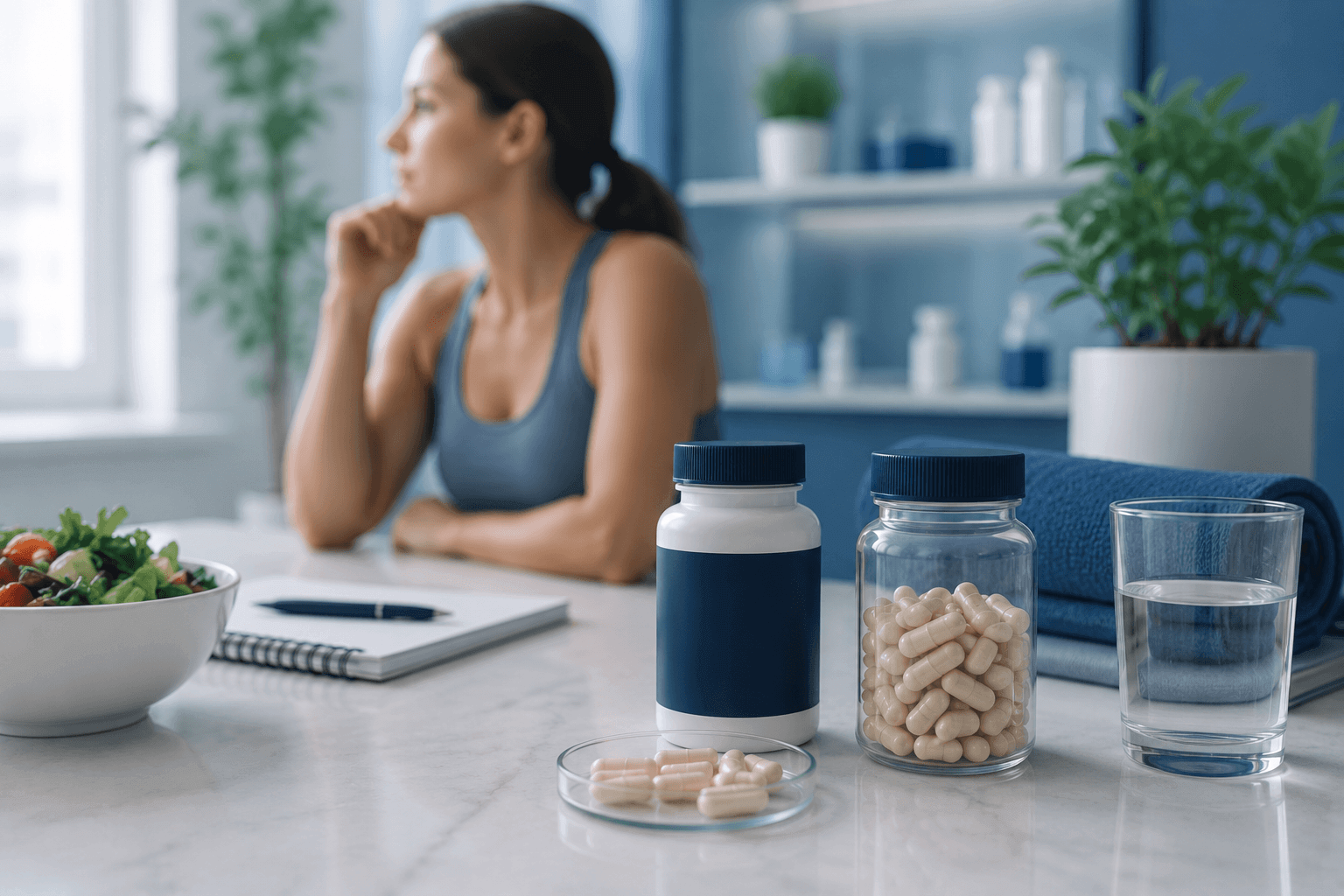
We want to be direct about the limits of what we sell, because a page like this is exactly where brands usually stop being direct.
A supplement supports. It does not replace. It cannot outrun a diet with no vegetables in it, a training programme that does not exist, or five hours of sleep a night. The research that makes our ingredients worth including was, almost without exception, conducted on people who were also eating reasonably and moving regularly, and the results should be read in that light. Anyone who tells you their capsule works regardless of everything else in your life is telling you something they cannot possibly know.
Effects are usually modest and usually gradual. Some people notice a difference quickly. Some notice it over weeks. Some notice very little, because their bottleneck was somewhere else entirely — and that is not a failure of the product so much as a mismatch between the product and the problem. We would rather set that expectation now than let you discover it after a month.
And we will not use the language of certainty where certainty does not exist. Nutritional science moves. Studies get replicated or they do not. Something we are confident about today may look different in five years, and if it does, we will change the formula rather than defend the old one because it happens to be selling.
The regulatory basics, stated plainly because they matter: these products are not designed to replace a varied and balanced diet. Do not exceed the stated dose. If you are pregnant, breastfeeding, taking any medication or managing a health condition, speak to your doctor before taking anything — including anything of ours. That is not legal throat-clearing. Interactions between supplements and medications are real, they are not always intuitive, and your doctor knows things about you that a label cannot.
Honest labelling, in the end, is not a feature we are proud of. It is the floor. We just think more of this industry should be standing on it.
Not everyone, and we would rather say so.
Fitlab Nutrition is built for people who are already doing the work and want to support it properly. The person who trains four times a week and wants to recover well enough to keep doing it. The person managing their weight through genuine changes to how they eat and finding that appetite, not motivation, is the thing that keeps breaking the week. The person whose digestion has been unsettled since a course of antibiotics and who has read enough to know that not all probiotics are the same. The person who is simply tired in a way that a coffee does not solve.
What they have in common is that they read the label. They want to know what a clinically relevant dose is. They are suspicious of anything that promises too much, and they have usually been burnt at least once by something that did.
If that is you, we think you will find us straightforward to deal with.
If what you want is a product that will do the work for you, we are not it, and we would rather you heard that here than found out later.

The feedback we value most is the least dramatic.
People tell us the products work best alongside their diet and training, and give an extra push rather than doing the job for them. That is precisely the sentence we hoped to read. It means the expectation we set was the expectation that was met — which, in a category built on overpromising, is a harder thing to achieve than it sounds.
They tell us they feel more energised and more focused, and that this makes it easier to stay with a routine rather than falling off it in week three. Consistency is where results actually live. Anything that makes the difficult days slightly less difficult is doing real work, even if it never makes a dramatic before-and-after.
They tell us the capsules are easy to take and that the products represent good value. Small things, but they are the things that decide whether a bottle gets finished or ends up at the back of a cupboard.
And some tell us they have tried a lot of things and these are the ones they have stayed with. We do not take that lightly, and we are aware it is a verdict that has to be re-earned with every batch.
We do not chase five-star reviews and we do not pretend our products are for everyone. What we would rather have is a customer who knew exactly what they were buying and found that it did what we said it would.
We intend to grow slowly and carefully. There are gaps in the range we would like to fill, and we will fill them when the evidence is strong enough to formulate something we would take ourselves — not before, and not because a category is trending.
We want to go further on transparency. More detail on sourcing. More accessible explanations of the research behind each formula, written for people rather than for regulators. Better answers to the question why this ingredient, at this dose, published where anyone can find them without having to email us.
We want to keep improving the formulas we already have, which means being willing to change them when the science moves — including when that is expensive and inconvenient and no customer would ever have noticed.
What will not change is the short list we started with. Doses that match the research. Labels that hide nothing. Independent testing on the finished product. UK manufacturing to standards we can point to. Formulas that more people can take. And language about what a supplement does that is still fair three months after you bought it.
If we ever quietly drop one of those, we will have become the thing Fitlab Nutrition was started to avoid. So please, hold us to it.